


Ploumanac’h discovery walk
Would you like to discover Ploumanac’h, voted France’s favourite village? Let yourself be carried away by its picturesque charm, narrow streets and small coves, ideal for hot summer days. See below for our recommended itinerary. For this walk, allow 1 hour for a distance of 1.57 km.
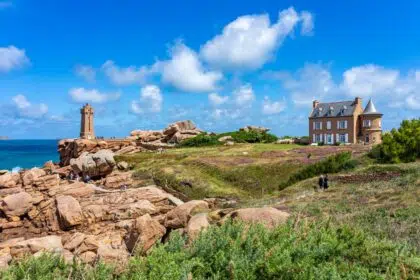
Departure from Saint-Guirec beach
A real treasure nestled in the heart of pink granite.
- To the right of the beach: the famous rock known as “Le Chapeau de Napoléon”. This natural monument made history in August 1944, serving as a code name for the general insurrection in Brittany during the Second World War.
- Facing the beach: the elegant silhouette of Costaérès castle is a real eye-catcher. This islet, acquired in 1892 by Polish engineer Bruno Abakanowiecz, was home to a holiday residence where he entertained friends, including Henryk Sienkiewicz, author of the novel Quo Vadis?
- To the left of the beach: Take advantage of the tide to visit the Saint-Guirec oratory, built in the 12th century in honor of this Welsh monk. A little further on, stairs lead up to the Saint-Guirec chapel, another heritage gem.
Continue your walk along the GR34 coastal path to extend this enchanting discovery.
Bastille beach
A place steeped in history, its name derives from its tumultuous past.
- 3rd century: Faced with incursions by Saxon pirates, the Roman Empire ordered the construction of fortifications every thousand paces (i.e. around 1.5 km). Among them, Castel Braz was the most imposing.
- 16th century: A rebel garrison took up residence in this fortification, turned it into a hideout and lived off pillaging. This episode came to an end when Henry IV’s army laid siege to Ploumanac’h castle and forced its surrender.
After its capture, the fortification was dismantled, and its stones reused to build the parapet of the Notre-Dame de La Clarté chapel.
The port of Ploumanac’h
Classified as a “Port of Heritage Interest”, this emblematic site boasts two unique tidal mills.
- A historic trading port: For centuries, this natural harbor, sheltered by majestic pink granite rocks, has been a hub of trade and commerce. During construction work, a sandstone vase containing gold coins from the Celtic Ossism people was discovered, testifying to their economic importance from Antiquity onwards.
- A gateway to Europe and the Mediterranean: In the 14th and 15th centuries, the port enjoyed flourishing trade, particularly with Europe and the Mediterranean. The tiled roofs still visible today are a reminder of the town’s trading links with England.
It was around this port that the first settlement of what would later become the commune of Perros-Guirec developed.
Return to Saint-Guirec beach along the hamlet’s picturesque lanes. Rue de la Fontaine and Rue de l’Oratoire reveal the charming 19th-century fishermen’s cottages known as Pentys.